
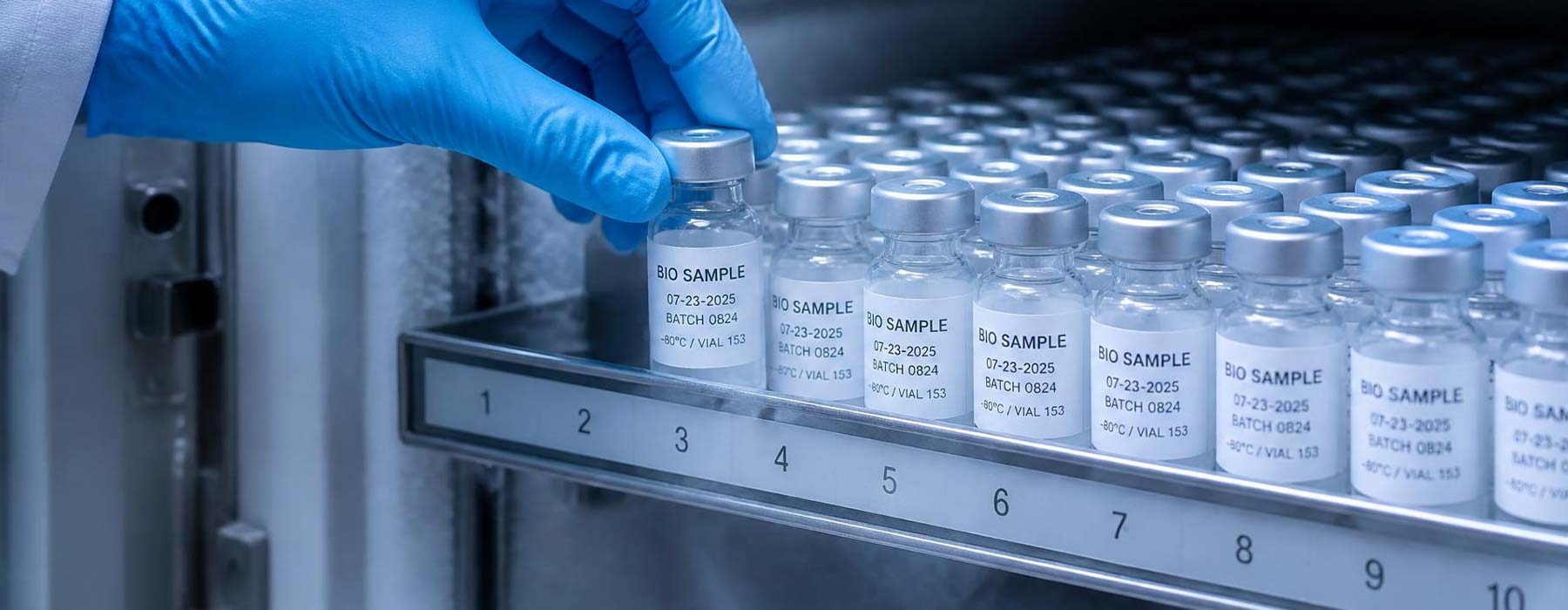
[fusion_dropcap boxed="yes" boxed_radius="0" class="fusion-content-tb-dropcap"]P[/fusion_dropcap]roper storage protects peptide integrity, prevents contamination, and ensures reliable experimental results. This is the standard procedure for keeping peptides stable, whether for a few days or several years.
Long-Term vs. Short-Term Storage
For long-term storage over months or years, peptides should be kept at -80°C (-112°F). Freezing preserves stability and functional integrity while minimizing degradation and oxidation.
For immediate or short-term use over days to weeks, peptides can be stored at 4°C (39°F). Lyophilized (freeze-dried) peptides remain stable at room temperature for several weeks.
- Avoid repeated freeze-thaw cycles, which accelerate degradation.
- Do not use frost-free freezers, since the temperature swings of their defrost cycles can harm peptides.
- Store peptides away from light in a cool, dry area.
Preventing Moisture and Oxidation
Two of the biggest threats to peptide stability are moisture and oxygen. To guard against moisture, allow frozen peptides to equilibrate to room temperature before opening the vial, which prevents condensation and moisture absorption.
- Minimize exposure to air and keep containers tightly closed.
- After use, reseal vials under a dry, inert gas such as nitrogen or argon to reduce oxidation risk.
- Peptides containing cysteine (C), methionine (M), or tryptophan (W) are especially prone to oxidation.
A useful tip: divide peptides into separate aliquots before experiments to reduce repeated air exposure and freeze-thaw cycles.
Choosing Storage Containers
Containers should be clean, chemically inert, clear, and structurally sound. Plastic and glass each have trade-offs.
- Polystyrene vials are clear but not chemically inert; polypropylene vials are translucent and chemically resistant.
- Glass vials are ideal for storage but prone to breakage during shipment.
- Peptides are often shipped in inert plastic, then transferred to glass for longer-term storage.
Lyophilized vs. Solution Storage
Lyophilized peptides have a much longer shelf life than peptides in solution. Peptide solutions degrade faster and are vulnerable to bacterial contamination, and peptides containing Cys, Met, Trp, Asp, Gln, or an N-terminal Glu are especially unstable in solution.
If solution storage is unavoidable, use sterile buffers at pH 5–6, aliquot to avoid repeated freeze-thaw, and store at 4°C for up to four to five weeks. Inherently unstable peptides should remain frozen.
Best Practices Summary
- Avoid repeated freeze-thaw cycles.
- Minimize exposure to air and light.
- Store in dark, dry, and cold locations.
- Prefer lyophilized peptides for long-term storage.
- Aliquot peptides according to experimental needs.
Following these guidelines helps ensure optimal peptide stability, purity, and reliability across research applications.
Share this article
Follow us
Latest articles

July 18, 2026
July 18, 2026
July 18, 2026