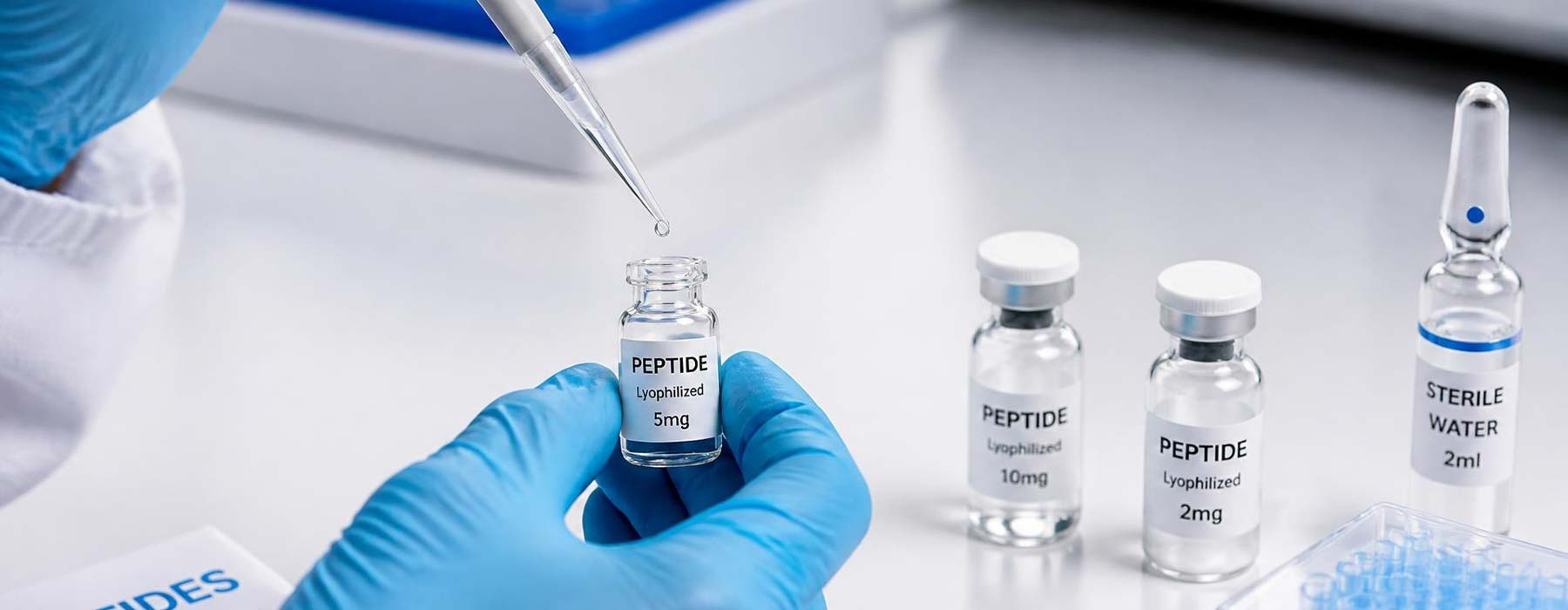
[fusion_dropcap boxed="yes" boxed_radius="0" class="fusion-content-tb-dropcap"]F[/fusion_dropcap]inding the right solvent to dissolve a peptide is one of the most challenging steps in peptide research. This guide explains what drives solubility and how to approach reconstitution methodically.
What Determines Peptide Solubility
Peptides are usually dissolved in aqueous solutions such as sterile water, but solubility problems are common, especially with peptides that contain long stretches of hydrophobic amino acids. The good news is that solubility can often be predicted by analyzing a peptide’s amino acid composition and physical properties.
Solubility is primarily governed by the peptide’s amino acids, which fall into four groups: basic, acidic, polar uncharged, and non-polar (hydrophobic).
- Peptides rich in non-polar or uncharged polar amino acids often dissolve better in organic solvents such as DMSO, methanol, isopropanol, DMF, or propanol.
- Peptides high in basic residues may dissolve better in mildly acidic solutions such as acetic acid, while peptides rich in acidic residues may dissolve better in basic solutions such as ammonium hydroxide.
- Avoid ammonium hydroxide with cysteine-containing peptides, as it can react adversely.
- Peptides with fewer than five amino acids generally dissolve easily and should be tested in sterile water first.
Steps for Proper Peptide Solubility
- Test small amounts first. Begin with a small sample to identify which solvent works best before committing your full quantity.
- Bring to room temperature. Let the peptide reach room temperature before attempting to dissolve it.
- Use gentle heat or sonication. Mild warming (up to 40°C / 104°F) or sonication can help dissolve peptides without disturbing their natural structure.
- Keep lyophilization as a backup. If a peptide won’t dissolve, it can be recovered by lyophilization and the process retried without losing material.
Predicting Solubility from Amino Acid Composition
You can estimate solubility by calculating a peptide’s net charge. Assign a charge of -1 to acidic residues (Asp, Glu, and the C-terminal COOH), +1 to basic residues (Lys, Arg, and the N-terminal NH2), and +1 to histidine at pH 6, then total them.
- A positive net charge points toward acidic solvents such as 10–30% acetic acid or a small volume of TFA.
- A negative net charge points toward basic solvents such as ammonium hydroxide (avoided when cysteine is present).
- Neutral peptides generally call for organic solvents such as acetonitrile, methanol, isopropanol, or small amounts of DMSO for hydrophobic peptides.
A note of caution: DMSO may oxidize peptides containing cysteine, methionine, or tryptophan, and strongly aggregating peptides may require 6 M guanidine hydrochloride or 8 M urea.
Dilution and Storage
- Dilute the dissolved peptide slowly into a buffered solution while gently and continuously agitating, to prevent local concentration spikes.
- Prepare stock solutions at higher concentrations than needed, then dilute as required for individual experiments.
- Store peptides at -20°C. Peptides containing cysteine, methionine, or tryptophan should be kept in an oxygen-free environment to prevent oxidation.
Share this article
Follow us
Latest articles

July 18, 2026
July 18, 2026
July 18, 2026